Where the Parliament Buildings are not situated in Vancouver, BC, they do reside close by on Vancouver Island, in beautiful Victoria, BC. The British Columbia Parliament Buildings are an integral part of the British Legacy, and for this reason should not be left out! They were built after the wooden Legislative Hall, termed the "Birdcages" were no longer structurally safe to house legislative representatives.
The Parliament Buildings are where members of the BC Government gather to make crucial decisions and pass laws for the province. Construction began of the buildings in 1893 by a British architect/immigrant named Francis Rattenbury, and completed in 1897. The Parliament Buildings run along Belleville Street in Victoria's downtown Inner Harbour, and are particularly unique due to the means in which they were built. All local materials and resources were used to construct the buildings, as it was important to the government to support local businesses during this critical time in BC. Where structural upkeep has been conducted in the last several decades, very little detail has been changed in the design of these buildings
The Parliament Buildings are 500 ft tall, composed of two tiers, waterfront walkways, garden sculptures, a marble dome, and have become a necessary tourist attraction when travellers visit the beautiful city. The buildings also light up with thousands of lights during nightfall. The success and beauty of the buildings led to more innovations and designs by Rattenbury, including the Legislative Library and Crystal Gardens in Victoria, as well as the Vancouver Art Gallery, a stunning building residing in downtown Vancouver.
Saturday, 10 August 2013
The British Properties
Europian immigrants first settled on the properties in the 1870's. When West Vancouver became a municipality in 1912 and passed the Town Planning Act in 1926, the area was determined to be for residential growth. The British Properties are made up of three prestigious neighborhoods referred to as Ambleside, Hollyburn Ridge, and Dundarave. During the Depression, the British Properties became impossible to afford, and in 1932 a Victorian engineer convinced the Guinness Family to purchase all 4700 acres, which were frequently visited by the King and Queen. Between 1931 and 1950, the Properties saw further changes that helped establish West Vancouver, including the construction of Lions Gate Bridge, which provided easier access into and out of the city.
Today the real estate situated on the British Properties are worth millions, and have been established as a peaceful haven from the city of West Vancouver. The views overlook the entire city, Mount Baker, as well as the Gulf Islands. Many of the original 1930's chalets still remain on the Properties today, but most of the homes have been drastically restored and are occupied by families, with square footage ranging from 15,000 to 40,000 per home. The British Properties have earned quite the reputation in the last few decades. Situated on the North Shore of Burrard Inlet in West Vancouver, the wealthy real estate available to purchase provides panoramic views, stunning architecture, and what has become a place for progressive urban development.
Empress Hotel (Hotel Vancouver)
Some may confuse the Empress Hotel in Vancouver with the Fairmont Empress Hotel situated in Victoria, BC, which is known for its' stunning history, decor, and afternoon tea. Where at one time, the Empress Hotel in Vancouver was a ritzy, sister hotel to the Fairmont, times have unfortunately changed. The eight story Empress Hotel in Vancouver resides on Hastings Street in the Downtown Eastside, and has become a safe haven for many trying to survive the reality that has become of this area. Where many flocked to the Hotel Empress for the comfort of an upper-class home to stay, the building still stands now 100 years old that many refer to as "a symbol for strength that many still call home".


The Empress Hotel was built between 1912 and 1913 by British architect F.N. Bender, and depicts Edwardian style and design of the late Victorian era. It actually used to be called the "New Empress Hotel", as it was built next to a neighbouring hotel, now called the Shaldon. It was once referred to as the "world's narrowest, tallest hotel", as the building is only two hotel rooms wide, and was the tallest building on Hastings Street back then. The interior finishing of the Empress Hotel, including white mosaic tile floors and marble stairwells, was designed to attract tourists and business men that were expected to arrive after the Canadian Northern Railway and the Panama Canal finished building in the early 1900's. It is hard to miss the Empress Hotel, as it also boasts three different forms of signage, one that is neon that was installed in 1940. Times have certainly changed, and Hotel Empress is not what it used to be, but is still considered an integral part of the British Legacy in Vancouver.
Thursday, 8 August 2013
Ballantyne Pier
Ballantyne Pier is a commercial and passenger dock at the Port of Vancouver. It also called Ballantyne Cruise Terminal. The pier was built in 1923 to lighten the dock shortages in Vancouver that came about during WWI. At the time it was the biggest port in the British Empire.
In 1995 the pier was gutted to create two modern cruise ship berths. It is currently used as for overflow for cruise lines.
The Dominion Building
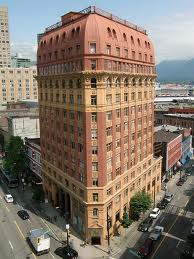
On the corner of West Hasting and Cambie Street stands the Dominion Trust building. Built from 1908-1910 by J.S. Heyler, it was the highest building in the British Empire standing at 53 meters high. This building is known as one of the most colourful and unique buildings in Vancouver. It is built around 10 stories of of spiral staircases with unique marble floors and Corinthian columns at the front entrance.
The Dominion Building now occupies a variety of offices along with Opus Arts Supplies and a restaurant.
Queen Elizabeth Park
Queen Elizabeth Park was created in 1902 and is located in the geographical heart of Vancouver. This city landmark originally sat on a small mountain 550 feet above sea level, however it no longer sits at this height as at the turn of the century it was quarried for rock to build the city's first roadways and remained an abandoned eyesore for decades.
In 1929 the Vancouver Park board acquired the property, and in 1930 this unsightly park was transformed into a blooming garden when the BC Tulip Association suggested turning the quarries into sunken gardens. By the end of the decade the Vancouver Parks Board acquired the site for park and recreation purposes, and was dedicated as such by the Commonwealth King and Queen at the time, King George VI and Queen Elizabeth, on a visit to Vancouver in 1939.
This 130 acre park receives approximately 6 million visits per year, and is second in the world in annual visits, with Stanley Park being number one.
Queen Elizabeth Park is home to various tourist attractions, such as the Arboretum, the Quarry Gardens, and the Bloedel Floral Conservatory. This site also houses a restaurant, various sculptures, a fountain with over 65 high powered jets, and a drinking water reservoir.
The Bloedel Floral Conservatory was the country's first geodesic conservatory surrounded by covered walkways, lighted fountains and a magnificent sculpture by artist Henry Moore. The conservatory contained many climatic zones which housed a huge variety of plants and vast selection of tropical birds, and was opened on December 6, 1969.
English Bay
English Bay is an area of water in an indentation of the shoreline of the Pacific Ocean, located South of Burrard Inlet and West of False Creek in Vancouver, British Columbia, Canada. The Stanley Park Seawall runs from Stanley Park to False Creek along the shoreline of English bay.
English Bay Beach, also called First Beach, is an immensely popular sunbathing, swimming, and sunset-watching destination for tourists and local Vancouverites alike. Locarno Beach, Spanish Banks beaches, Jericho Beach, Kitsilano Beach, Sunset Beach, Second Beach, Third Beach and Ambleside Beach are other major oceanfront tourist destinations located along the shoreline of English Bay.
English Bay and nearby Spanish Banks were named in 1859 by Captain Richards in commemoration of the meeting here in June 1792 between the English under Captain Vancouver and the Spanish under Captains Galiano and Valdes.
English Bay Beach, also called First Beach, is an immensely popular sunbathing, swimming, and sunset-watching destination for tourists and local Vancouverites alike. Locarno Beach, Spanish Banks beaches, Jericho Beach, Kitsilano Beach, Sunset Beach, Second Beach, Third Beach and Ambleside Beach are other major oceanfront tourist destinations located along the shoreline of English Bay.
Subscribe to:
Posts (Atom)


.jpeg)